03 // Structural, Electronic, and Thermal Polymers
THE OTHER FOUR FAMILIES
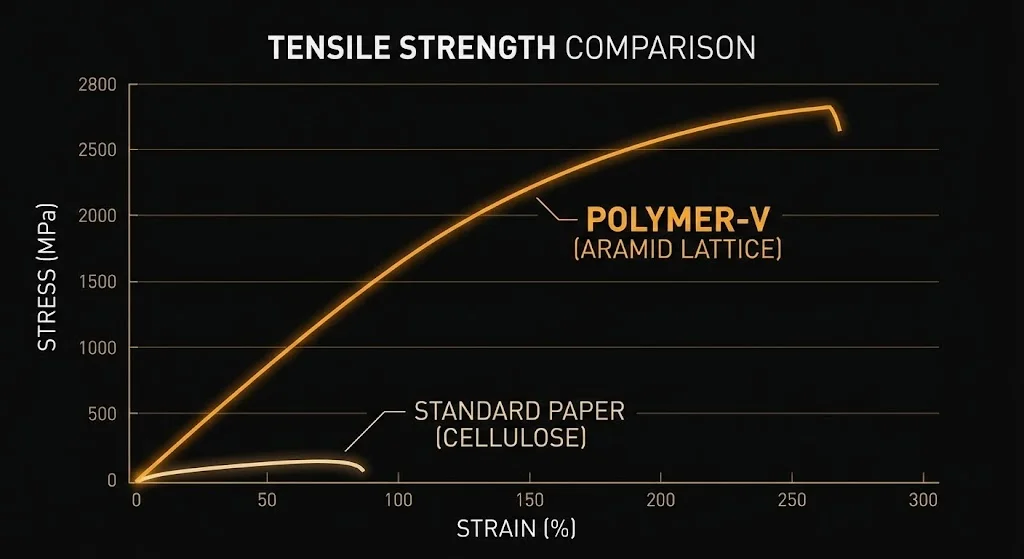
CROSS-LINKED ARAMID — A SINGLE MOLECULE, NOT A WOVEN FABRIC
Structural composites. A cross-linked polymer film is a single molecule. Every monomer is covalently bonded to its neighbors through a three-dimensional network. When a projectile strikes it, the load distributes to every bond simultaneously. Polymer-V Standard (4-ply, 2.1 mm): rated for fragmentation and small-arms threat. Polymer-V Tactical (6-ply, 3.4 mm, ceramic-seeded impact layer): rated for armor-piercing rifle rounds. Polymer-V Marine: anti-biofouling fluoropolymer topcoat, 50-year UV exposure rating, pH 1–14 chemical resistance. Used by Modular Habitats.[6]
Electronic polymers. Poly-Flex: polyimide flexible circuit substrate, CTE-matched to copper at 17 ppm/°C, survives >100,000 flex cycles at 1 mm bend radius. The conformal sensor arrays for Brainwave Systems, the antenna mesh for Lorentz Aerospace, the sensor skin on Foundation Kinetics robots. Poly-Shield: 300 kV/mm breakdown strength for Maxwell Continuum capacitor banks.[7]
Thermal barriers. Polymer-V Thermal: zirconia-reinforced ceramic-fiber interlayer rated for 1,200°C sustained exposure. Interior liner for Stellar Furnace reactor exteriors. Phase-Change Film: 180 kJ/kg latent heat capacity, passive thermal management for Aetheric Sciences quantum processor housings. Ablation Shield: sacrificial phenolic-aramid composite for Lorentz Aerospace trans-medium re-entry.[8]
Biomedical scaffolds. Substrate-X/BIO: pH-responsive cross-linker that polymerizes on contact with cellular media. A flat film seeded with stem cells progressively hardens into three-dimensional scaffold geometry. Developed with Cellular Foundry.[9]
04 // The Leviathan — Molecular Alignment Foundry
200 METERS OF VACUUM-GRADE POLYMER FABRICATION
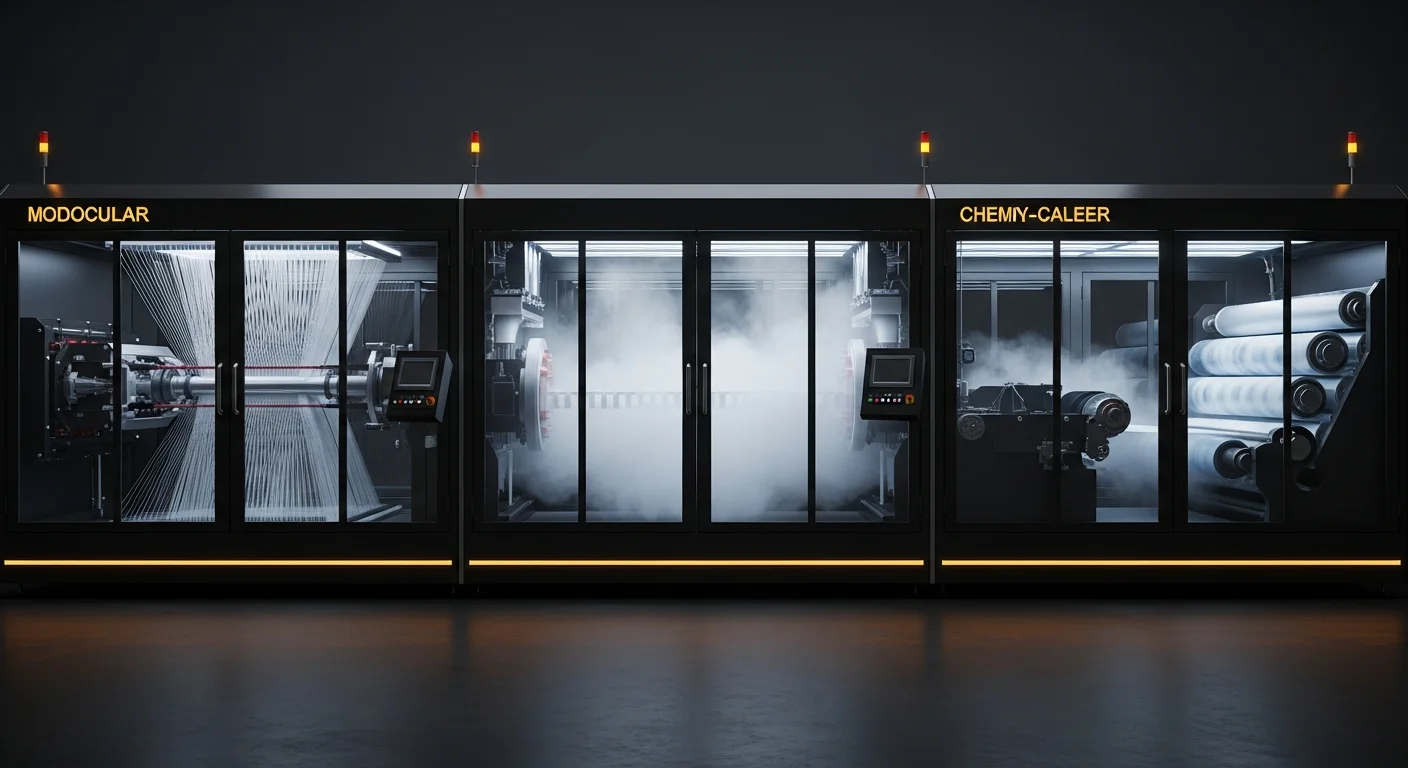
FIG 3.0: THE LEVIATHAN — NOT AN EXTRUDER. A MOLECULAR LOOM.
All Polymer Press films are produced on a single 200-meter linear system that weaves polymer chains at the molecular level. Differentiation between material families is achieved through dopant formulation and post-processing — the backbone process is invariant.[10]
Zone 1: The Molecular Loom. Raw precursor monomers synthesized under hard vacuum (<10−5 Torr). As the liquid polymer exits the die, an electro-hydrodynamic alignment field orients every chain in the direction of travel, creating the “grain” of the film and maximizing tensile strength. Off-axis weaving at ±15° provides biaxial resistance.[11]
Zone 2: The Dopant Fog. Functional additives infused via physical vapor deposition — carbon precursors for photonic substrates, cross-linkers for structural grades, phase-change capsules for thermal films, conductive polymer dopants for electronic grades, leuco-dye nanocrystals for Substrate-X Chroma.[12]
Zone 3: The Cryo-Calender. Polished rollers chilled to −80°C by liquid nitrogen lock the molecular structure. The flash freeze prevents active chemicals from reacting prematurely. The film exits Zone 3 as finished product — wound onto coreless magnetic spools under constant tension. Inline SEM imaging at 10,000× confirms fiber alignment. Batch yield: 99.2%.