Polymer Press
ENGINEERED POLYMER SUBSTRATE & ADAPTIVE MATERIALS
POLYMER PRESS
Polymer Press engineers polymer systems as the boundary layer between extreme physics and usable products. The flagship substrate, Polymer-V, is a four-ply co-extruded composite that ships into Plasma Press as ablation-grade book stock, into Phase Flash as hydrophobic collection geometry, into Matter Kitchen as microwave-transparent food pods, and into Lorentz Aerospace as cryogenic-warm thermal isolation. Each application requires a different polymer chemistry; the discipline is the engineering of those chemistries against the same manufacturing chassis.
Conventional materials engineering forces tradeoffs: lightweight or strong, flexible or heat-resistant, insulating or formable, chemically inert or extrudable. The Polymer-V product family eliminates the binary tradeoffs by engineering polymer chemistry at the layer scale — each layer of the composite is optimised for one constraint, and the layers stack into a single bonded substrate that satisfies all of them.
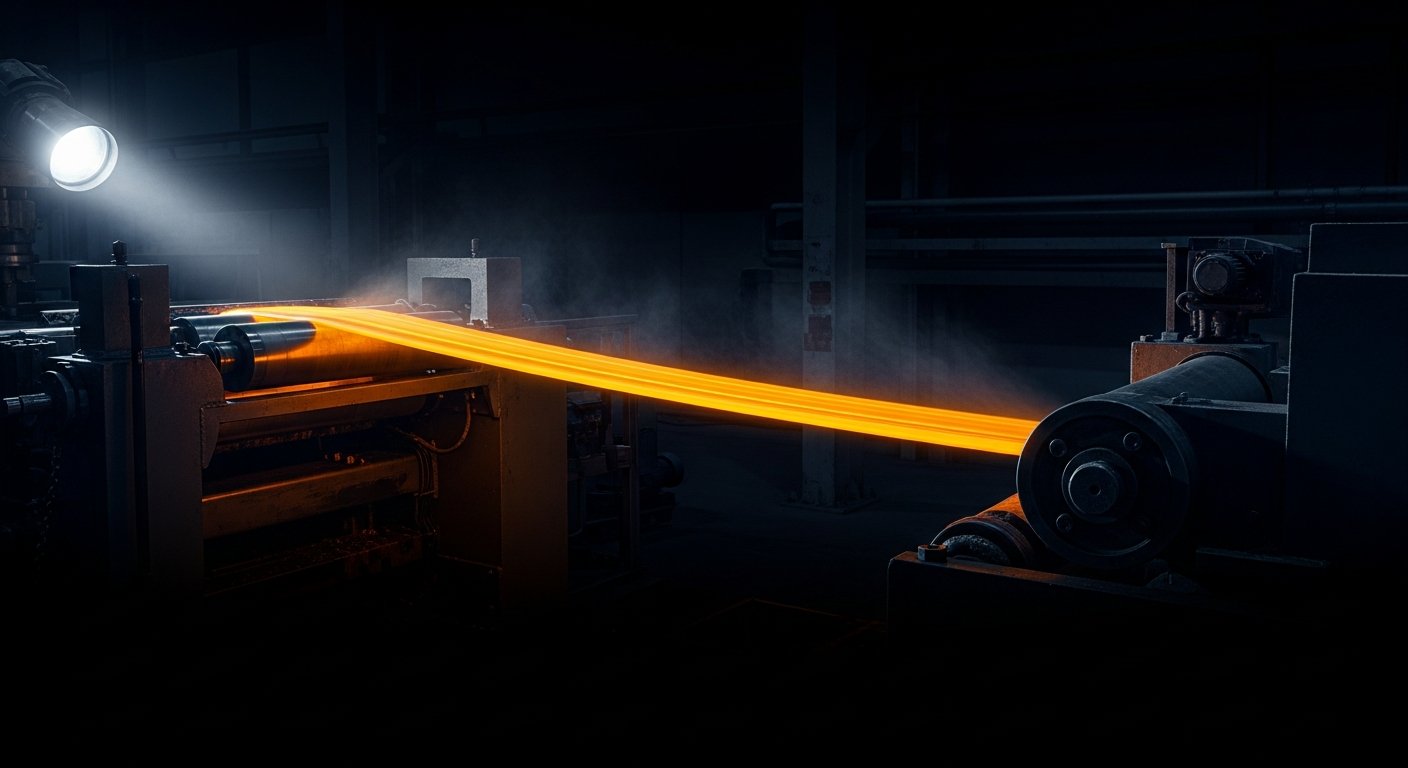
We do not sell plastic. We sell engineered envelopes. Each polymer layer carries one constraint; the stack carries the product.
01 — The Discipline
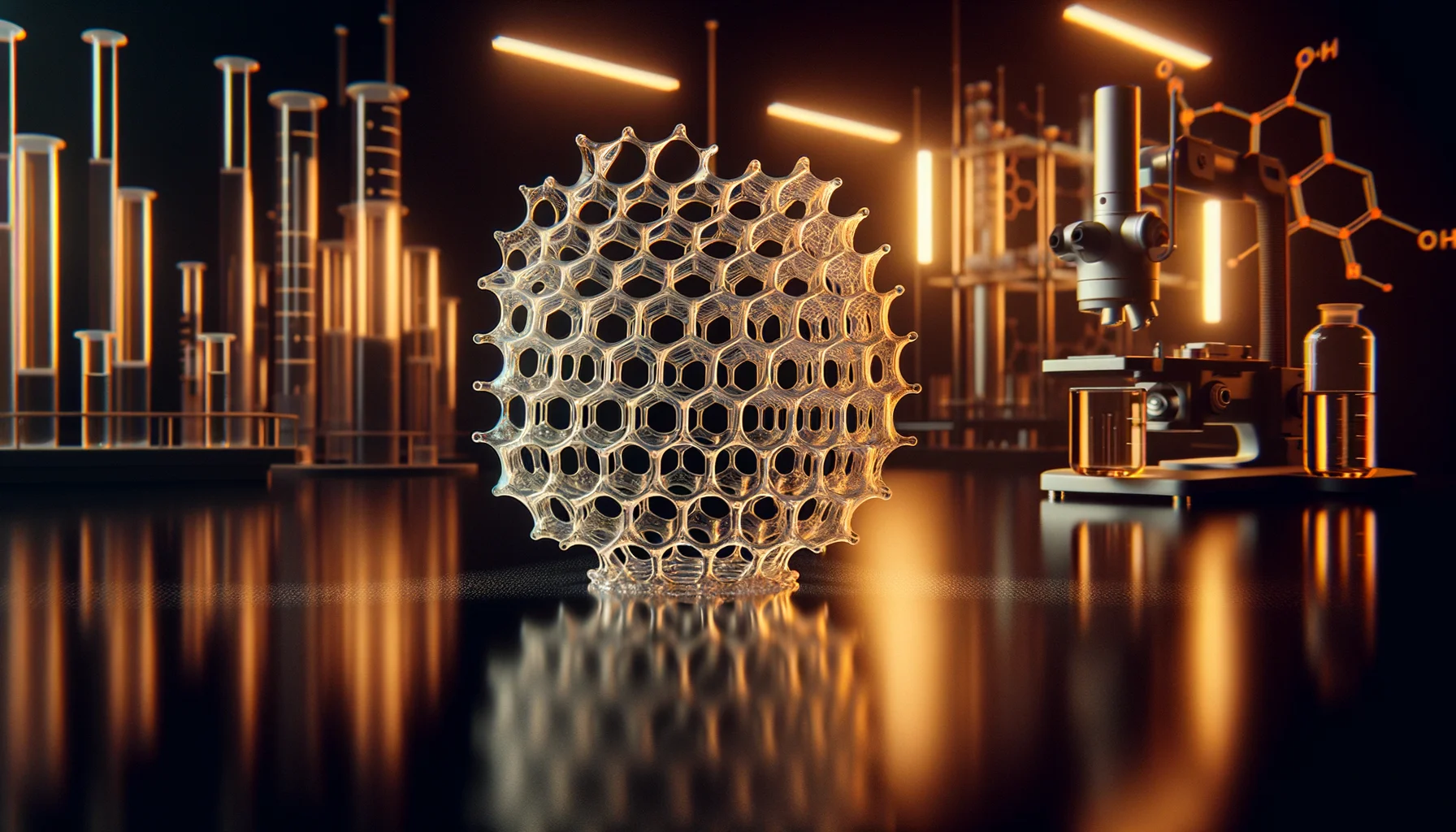
BIOMEDICAL SUBSTRATE
An engineered polymer is a small molecule chain repeated millions of times in a controlled topology. The repeat unit determines the chemistry — thermal stability, dielectric strength, chemical resistance, optical clarity, biocompatibility. The topology determines the mechanics — tensile strength, elasticity, glass-transition temperature, anisotropy. Combining the two dimensions over the polymer-chemistry landscape produces an enormous design space; the discipline of Polymer Press is navigating that space deliberately rather than picking off-the-shelf grades.1
The deliverable is rarely a single polymer. It is a co-extruded composite stack: layer one carries the surface chemistry the application needs (hydrophobic for water dispensing, ablation-tunable for laser writing, microwave-transparent for volumetric cooking), layer two carries the structural backbone (cross-linked aramid, polyimide, PEEK), layer three carries the functional response (chromophore-doped for ablation contrast, electrically conductive for shielding, dielectric for high-voltage), and layer four carries the bonding chemistry that joins the stack to whatever it sits against. Each layer is engineered as a separate problem; the manufacturing chassis (multi-die co-extrusion through a controlled-thermal-profile head) is shared.2
The discipline rejects the "commodity plastic" framing. Polymer engineering at the layer scale is closer to semiconductor process engineering than to bulk-resin manufacturing: nanometre-scale layer thicknesses, chromophore doping at parts-per-million precision, surface energy controlled to milli-Joules per square metre. The product line is the cross-product of chemistry choices the discipline supports against the application-driven layer stacks customers specify.
02 — The Bottleneck

FLEX CIRCUIT
Conventional engineering polymers force binary tradeoffs because the entire bulk substrate must compromise across constraints. A polymer with good high-temperature stability (polyimide) is poor at forming. A polymer with good optical clarity (PMMA) is poor at thermal cycling. A polymer with food-contact biocompatibility (FDA-cleared polyolefins) cannot withstand the temperature rise of volumetric microwave cooking. Each application historically required a different bulk polymer, with the engineering compromise distributed across the whole product.3
The deeper bottleneck is the manufacturing chain. A new bulk polymer requires a new resin synthesis line, a new extrusion train, a new annealing oven, and a new quality-control protocol. Capital cost of bringing a new polymer to industrial volume runs into tens of millions of dollars; time-to-market is years; the polymer industry has converged on a small number of high-volume grades and treats deviation from those grades as a custom-engineering premium.4
The Polymer Press thesis is that the layer is the right unit of engineering, not the bulk substrate. A single multi-die co-extrusion head can produce arbitrarily many stack permutations from a fixed library of layer chemistries. Doubling the application footprint means adding a new layer recipe, not building a new manufacturing line. The capital cost amortises across the composite product family, not across each application.
03 — The Material Envelope
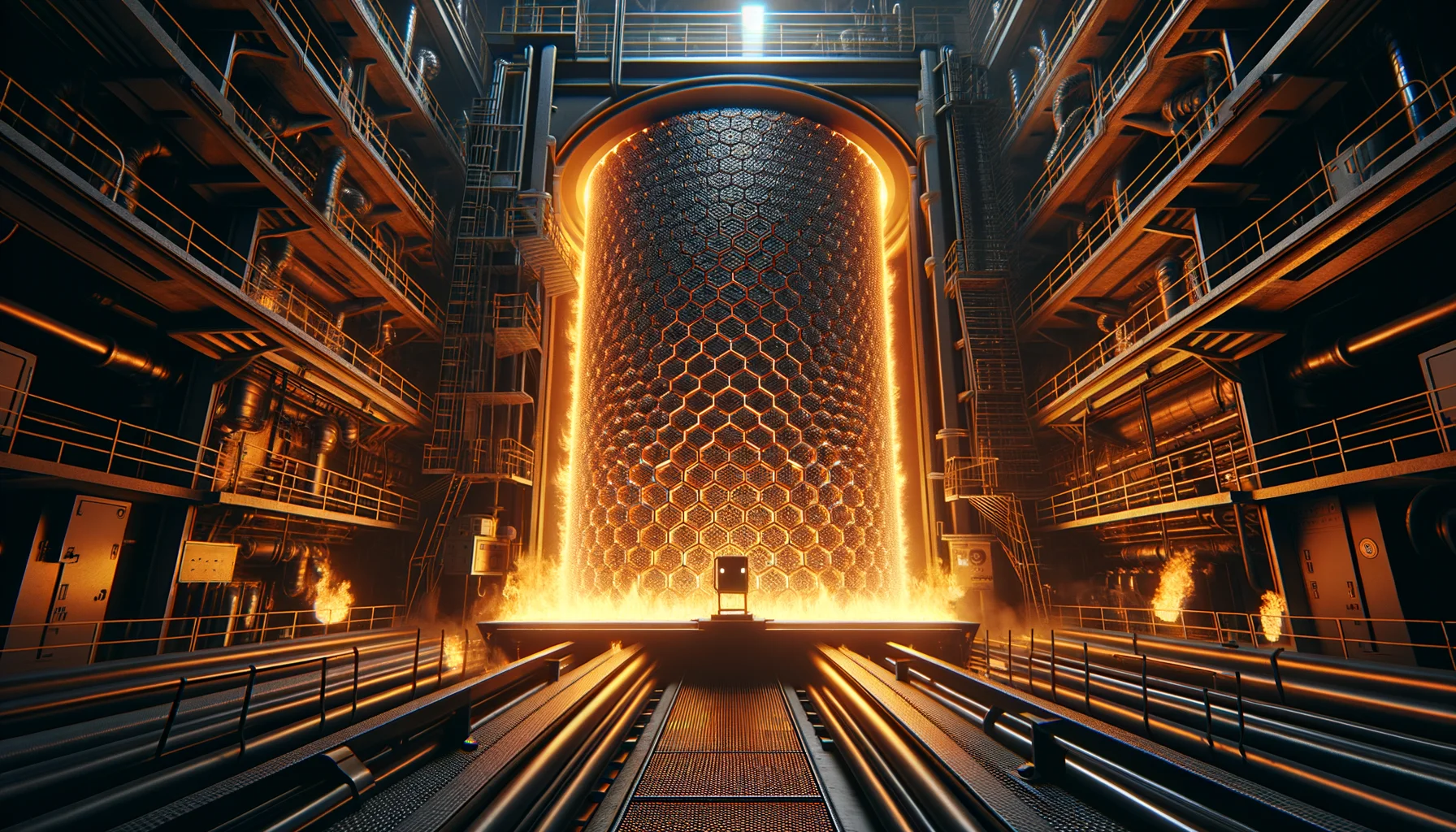
HIGH TEMP BARRIER
The Polymer-V product family is the flagship envelope substrate. The standard configuration is a four-ply composite spanning approximately 80 micrometres total thickness:5
Application-specific top layer. Hydrophobic nano-ceramic matte for water-dispensing surfaces (Phase Flash collection trough, laminar dispensing column). Ablation-tunable chromophore-doped layer for laser-written publishing (Plasma Press Polymer-V book substrate). Microwave-transparent low-loss tangent layer for volumetric food-contact (Matter Kitchen batter pod). FDA-cleared biocompatible variant for medical and food-safe applications.
The active layer. A dense hydrocarbon polymer engineered for the application's primary functional response: instant ablation under femtosecond pulse (publishing), controlled vapor-pressure release on microwave heat (cooking pod seal), high dielectric breakdown strength (insulation for fusion-coil applications). Chromophore loading, dopant concentration, and chain length are tuned per recipe.
The structural skeleton. Cross-linked aramid weave (chemistry adjacent to Kevlar) provides tensile strength roughly ten times that of standard bond paper. For substrate carriers (publishing book stock), this means a finished book that is essentially impossible to tear by hand. For pressure-bearing applications (Phase Flash collection vessel), the aramid backbone provides the burst-strength margin against the chamber pressure cycle. For aerospace applications (Lorentz hull insulation), the aramid weave provides the dimensional stability across the cryogenic-to-warm thermal cycle.6
The base interface layer. Adhesive chemistry tuned to the substrate the Polymer-V composite is bonded against: metallic surface (Phase Flash chamber wall), ceramic substrate (Matter Kitchen pod cassette), other polymer (Modular Habitats insulating panel), or self-bonding (Plasma Press book spine fold-and-seal). Cure chemistry varies per bonding mode — UV-cured for inline transparency, heat-cured for high-strength permanent joints, pressure-sensitive for releasable applications.
04 — Processing and Forming Stack
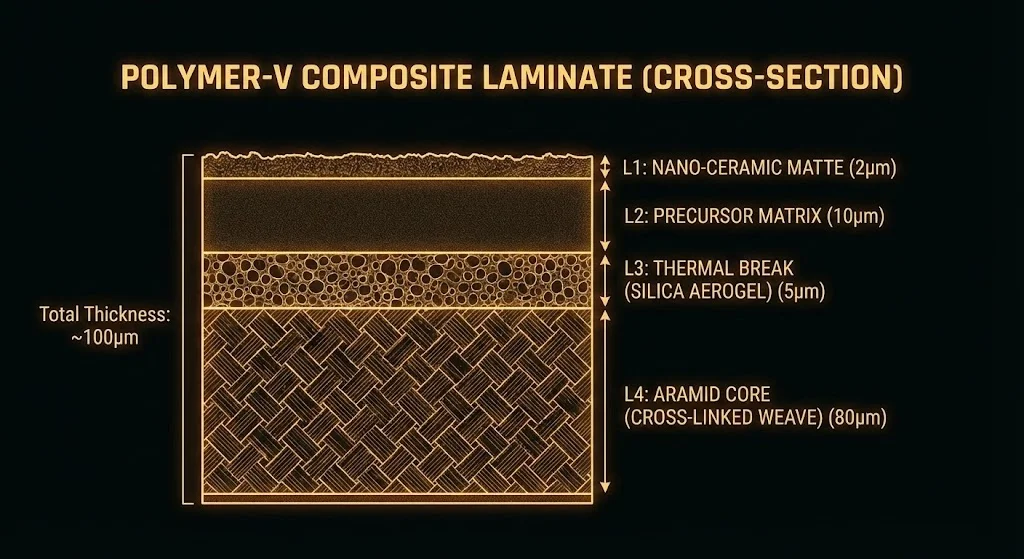
LAYER STACK
Beyond the co-extrusion chassis, the Polymer Press processing stack supports several secondary forming operations that adapt the base substrate to specific product geometries.
Vacuum thermoforming. The Polymer-V stack softens at L2's glass-transition temperature (typically 130°C) and reshapes against a heated mould under vacuum. This produces the curved Parabola receivers, the Matter Kitchen batter pod walls, and the Modular Habitats interior panel skins. The process preserves the layer stack: surface chemistry stays on top, backbone retains its anisotropy.7
Femtosecond surface texturing. A sub-picosecond laser scan engraves controlled micro-topography into the L1 surface layer at sub-micrometre resolution. The technique produces hydrophobic patterns (lotus-leaf microcavities) without changing the bulk substrate. Applications include the laminar-flow honeycomb in Phase Flash dispense, the friction-controlled grip surfaces in Foundation Kinetics fixturing, and the optical-diffuser surface in Maxwell Continuum diagnostic windows.
Reactive lamination. Where the application requires a layer not supported by the co-extrusion chassis (metallic foil for RF shielding, carbon-veil for static dissipation, ceramic precursor for high-temperature service), a secondary lamination step bonds the additional layer through a reactive interfacial chemistry. The Polymer-V substrate carries the geometry; the laminated layer carries the function the polymer alone cannot.
Pressure membrane casting. For Phase Flash and similar pressure-cycling applications, the Polymer-V backbone is reinforced with a high-strength inner-fibre weave and cast under controlled pressure to produce burst-rated membranes. Burst strength scales with the fibre architecture; standard membrane configurations carry pressure cycles from sub-vacuum to forty atmospheres.8
Foam expansion. Closed-cell polymer foam variants serve as thermal insulation between cryogenic and ambient volumes (Lorentz hull insulation, Modular Habitats wall cores). Cell size, density, and conductivity are tunable through the expansion process; the same Polymer-V chemistry serves the foam role.
05 — Interface Materials
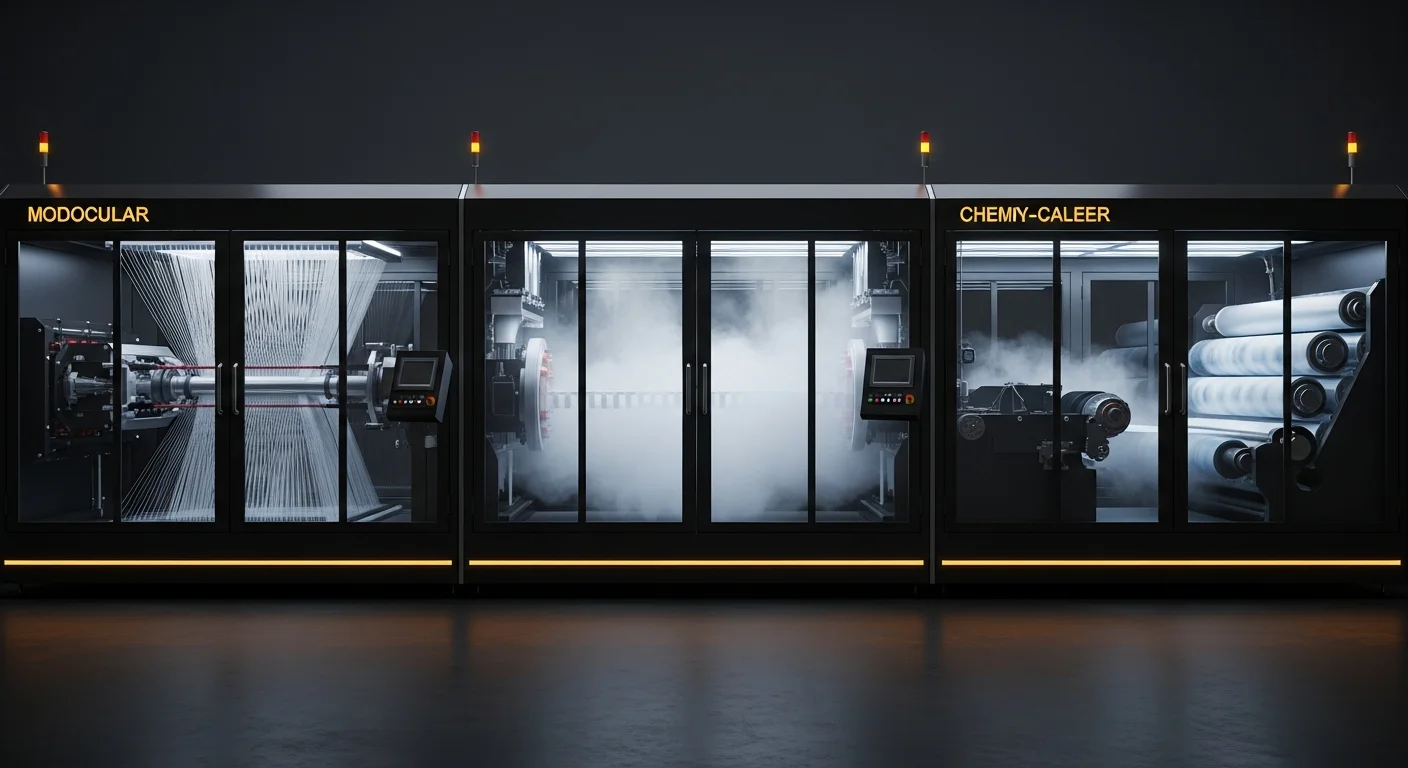
LEVIATHAN MACHINE
Interface engineering is the practical consequence of layer-scale design. The same Polymer-V chassis ships into wildly different operating environments because the L1 surface chemistry adapts:
The interface-class library is the engineering surface where customer applications meet the Polymer-V chassis. A new interface class requires new L1 chemistry (a development cycle measured in months); a new product configuration within an existing class requires only a new stack recipe (a development cycle measured in days). The library compounds; each interface class added expands the addressable product surface.
06 — Supplier & Integration Partners

MARINE FILM
Polymer Press is the upstream substrate supplier to the machine-building network. Its outputs feed the flagship products of seven peer companies; its own inputs come from refractory chemistry suppliers + the network's robotic-manufacturing capability.
Plasma Press — Polymer-V publishing substrate. Chromophore-tuned L1+L2 chemistry. Cassette form factor co-developed; the substrate is the consumable in the One-Second Book platform.
Phase Flash — Hydrophobic L1 + structural backbone for collection trough, honeycomb flow-straightener, Parabola receiver. Pressure-cycling membrane variant for the chamber assembly. Foam variant for cryogenic-jacket thermal isolation.
Matter Kitchen — Refrigerated batter-pod polymer: microwave-transparent below 4 GHz, melt-releasable at higher frequencies, food-safe over 4°C-to-200°C, repeatedly mouldable at industrial volume.
Lorentz Aerospace — Polymer-V mandrels for coil winding (1,440 segments per XR-1). Engineered polymer thermal insulation between cryogenic and warm-interior volumes. Substrate engineering for vehicle skin underlays.
Modular Habitats — Interior panel substrate, foam wall cores, vapour-barrier membranes. Closed-cell foam thermal isolation rated for sustained sub-zero outdoor service.
Stellar Furnace — High-voltage dielectric L2 for capacitor-bank insulation in the pulsed-power section. Refractory polymer composite for non-plasma-facing instrumentation.
Highfield Magnetics — Insulation between superconducting coil layers. Cryogenic-rated foam jacket inserts. Dielectric L2 for quench-protection circuitry.
Foundation Kinetics — Joint development of the co-extrusion cell automation, mould design, and downstream forming-station integration. Foundation Kinetics's machine vision QA covers Polymer-V layer-thickness verification at sub-micrometre resolution.
Fermat Logistics — Sigma-1 standard-cargo handling of Polymer-V cassette shipments. Sigma-2 cold-chain handling of pre-formed Matter Kitchen pods.
Plasma Press → Phase Flash → Matter Kitchen → Lorentz Aerospace → Modular Habitats → Stellar Furnace → Highfield Magnetics → Foundation Kinetics → Fermat Logistics →
07 — Validation Hooks
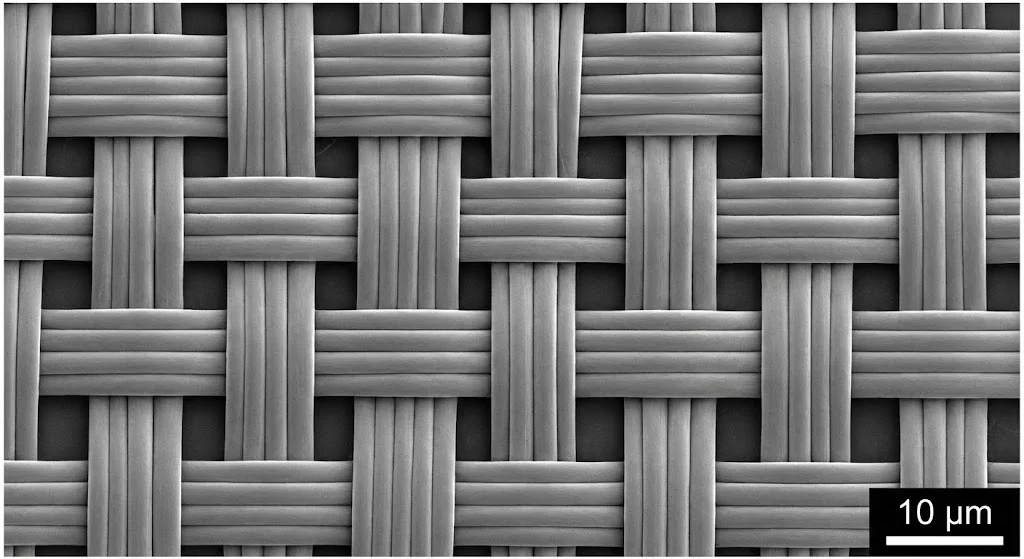
MICROSTRUCTURE SEM
Four measurable claims define the forward roadmap. Each is intended to be a future Crystal Ball-grade prediction registration once the prediction infrastructure exists.
HOOK A — high-temperature polymer service envelope. Today's Polymer-V backbone operates from cryogenic to 200°C. The forward target is a high-temperature variant (Polymer-V/HT) with a 350°C service ceiling, opening applications in next-generation fusion-coil insulation and aerospace skin underlays where current polymer service ceilings force exotic-ceramic alternatives. A demonstration of 1000-hour service at 350°C under cyclic thermal load with dielectric retention above 80 percent of room-temperature baseline is the gating measurement.9
HOOK B — dielectric breakdown above 250 kV/mm. The current Polymer-V dielectric L2 reaches roughly 150 kV/mm under controlled conditions. A factor-of-two improvement would allow thinner insulation in superconducting coil assemblies, freeing volume in the Iron Horse and God Magnet platforms. Demonstration of sustained 250 kV/mm at room temperature and 200 kV/mm at 20 K cryogenic operation is the gating measurement.10
HOOK C — recyclable composite stack. The current Polymer-V stack is functionally permanent — the cross-linked aramid backbone is not depolymerisable at industrial scale. The longer-term research target is a Polymer-V/R variant whose layers are individually de-bondable and recyclable into the same chemistry feedstock. Demonstration of a full disassembly-and-rebuild cycle at industrial volume with no degradation of material properties is the gating measurement.11
HOOK D — outgas rate below 10⁻¹° Torr·L/s/cm². Ultra-high-vacuum applications (advanced Plasma Press, next-generation Vapor Vacuum tools, electron-beam systems) require polymer outgas rates an order of magnitude below today's UHV-grade Polymer-V. A demonstration of sustained sub-10⁻¹° outgas in a sealed test fixture over 1000 hours is the gating measurement.12
These hooks define the forward surface where polymer chemistry research enters the Polymer Press roadmap. Edison observability of papers on high-temperature polyimide variants, dielectric polymer blends, depolymerisable composites, and UHV-grade outgas characterization would feed forward into prioritisation. The integration is left as a future build, not implemented in this sprint.
RESEARCH REPOSITORY
Polymer chemistry, composite engineering, membrane systems, dielectric materials, thermal protection, and additive manufacturing.
Polymer Press is the engineering of polymer systems as industrial substrate. The discipline is layer-scale composite design: each ply of the Polymer-V family carries one constraint, and the stack carries the product. The substrate ships into machine-building applications across the network — publishing, food, vacuum, plasma, dielectric, cryogenic, optical, and microwave — through a single co-extrusion chassis that amortises capital across the product family.
(wiki) Polymer • (wiki) Aramid Fibre • (wiki) Polyimide • (wiki) PEEK
Reference Links — Composites & Manufacturing(wiki) Coextrusion • (wiki) Composite Material • (wiki) Thermoforming • (wiki) Polymer Foam
Reference Links — Membranes & Surface Engineering(wiki) Membrane Technology • (wiki) Superhydrophobic Coating • (wiki) Surface Energy • (wiki) Dropwise Condensation
Reference Links — Dielectric & UHV(wiki) Dielectric Strength • (wiki) Outgassing • (wiki) Ultra-High Vacuum • (wiki) Permittivity
- Sperling, L.H. Introduction to Physical Polymer Science. 4th Ed. Wiley, 2005. ISBN 978-0-471-70606-9.
- Mark, J.E. (ed.) Physical Properties of Polymers Handbook. 2nd Ed. Springer, 2007. ISBN 978-0-387-31235-8.
- Mittal, V. Polymer Nanocomposites: Synthesis, Characterization, and Modeling. ACS, 2010. ISBN 978-0-841-22506-8.
- Throne, J.L. Technology of Thermoforming. Hanser Gardner, 1996. ISBN 978-1-569-90198-4.
- Mulder, M. Basic Principles of Membrane Technology. 2nd Ed. Springer, 1996. ISBN 978-0-792-34247-1.
- Tanaka, T. et al. "Polymer nanocomposites as dielectrics and electrical insulation." IEEE Trans. Dielectr. Electr. Insul. 11, 763–784 (2004). Foundational dielectric-polymer composite reference.
- Wong, T.S. et al. "Bioinspired self-repairing slippery surfaces with pressure-stable omniphobicity." Nature 477, 443–447 (2011). The reference paper for engineered hydrophobic polymer surfaces.
- Pickering, K.L. et al. "A review of recent developments in natural fibre composites and their mechanical performance." Composites Part A 83, 98–112 (2016).
- Jenness, N.J. et al. "High-temperature polymer dielectrics for capacitor applications." J. Phys. Chem. C 122, 19751–19767 (2018).
- ● Engineered polymer design space: standard polymer science. The chemistry-times-topology combinatorial space is the basis of all polymer engineering curricula.
- ● Multi-die co-extrusion chassis: established industrial polymer technology; the layer-scale-per-application engineering approach is the program differentiator.
- ● Binary-tradeoff bulk polymer limitations: standard materials engineering reality. Documented across the polymer industry.
- ● Manufacturing capital cost for new bulk polymer line: standard industry economics; tens of millions of dollars and multi-year timelines are typical.
- ● Polymer-V four-ply standard configuration: program-target stack. Layer-scale engineering of each ply is the engineering work.
- ● Cross-linked aramid tensile strength: standard aramid mechanical data. Cross-linked variants exceed bond paper by an order of magnitude.
- ● Vacuum thermoforming: established polymer-forming technology. Sub-millimetre dimensional accuracy is industry-standard.
- ● Pressure-membrane casting at 40-atmosphere burst rating: engineering program; standard membrane technology, application-tuned for Phase Flash chamber.
- ● Polymer-V/HT 350°C service envelope: engineering target. Today's polyimide grades reach this in static service; sustained cyclic operation is the open work.
- ● 250 kV/mm dielectric strength: theoretical for engineered polymer-nanocomposite stacks. Laboratory demonstrations exist; industrial-volume manufacturing is the open work.
- ● Recyclable composite stack: long-term research target. Depolymerisable chemistries exist for some polymer classes; full-stack recyclability with property retention is speculative frontier.
- ● Sub-10⁻¹° outgas rate: theoretical for next-generation low-outgassing polymer variants; demonstration in sealed UHV fixtures is the gating measurement.