Polymer Press
ANHYDROUS ARAMID LATTICE
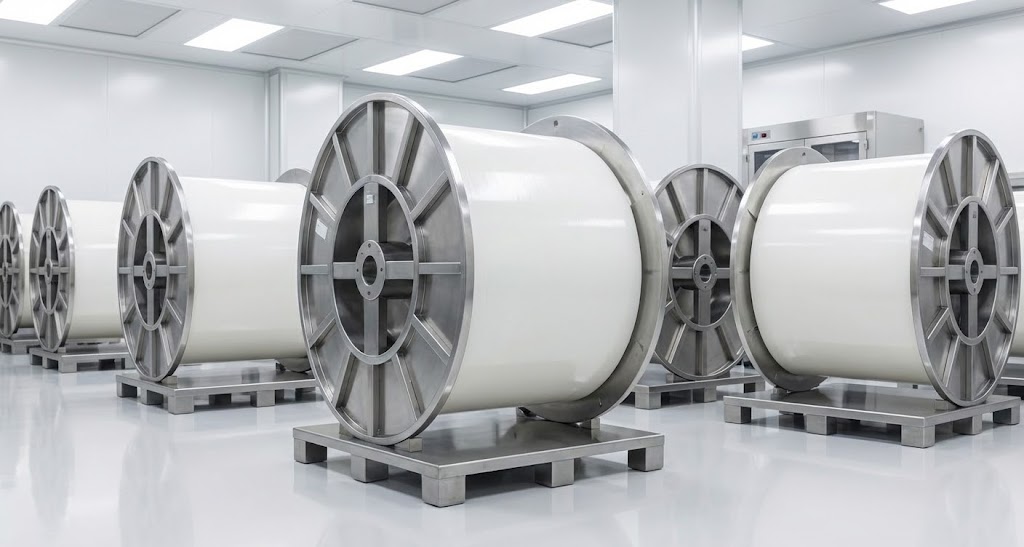
FIG 1.0: RAW "POLYMER-V" REEL STOCK
Paper was designed for the pen. Polymer-V was designed for the laser.
We do not grow trees to make our medium. We build it, molecule by molecule. Polymer-V is a synthetic aramid lattice designed specifically for the vacuum chamber of the Codex Machine.
It creates a perfect contrast ratio because the material itself changes state. It is not ink on paper; it is carbon on polymer. The bond is molecular. The durability is absolute.
01 // CHEMISTRY: THE VACUUM PROBLEM
The Issue: Outgassing. Standard paper contains ~5% moisture. In the 10-6 Torr vacuum of the Plasma Press, that moisture boils instantly, creating steam pockets that destroy the sheet.
The Solution: Anhydrous Construction. Polymer-V is 100% synthetic and contains zero water. It remains chemically inert in a hard vacuum, allowing for high-speed transport without degradation.
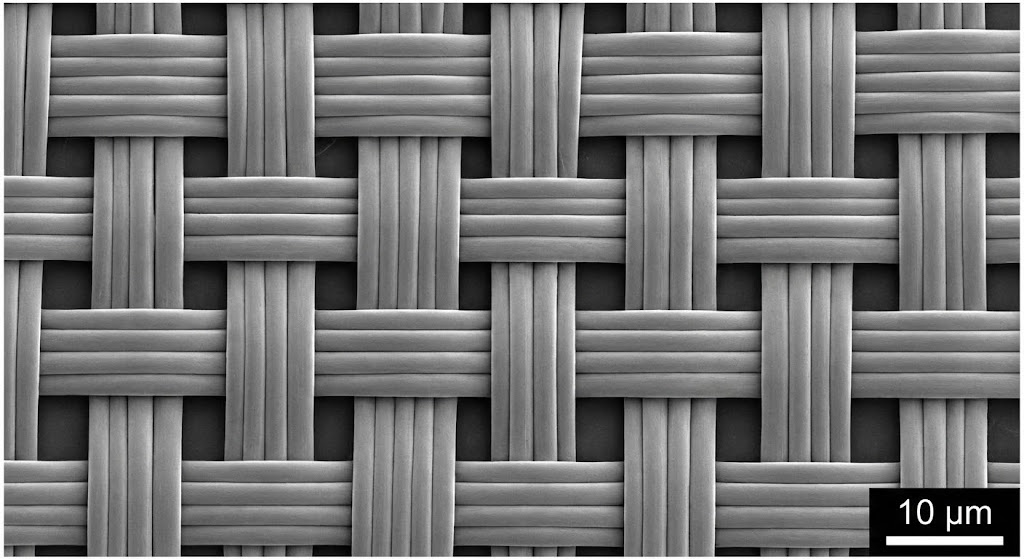
FIG 2.0: SEM VIEW OF LATTICE STRUCTURE
02 // STRUCTURE: CROSS-LINKED ARAMID
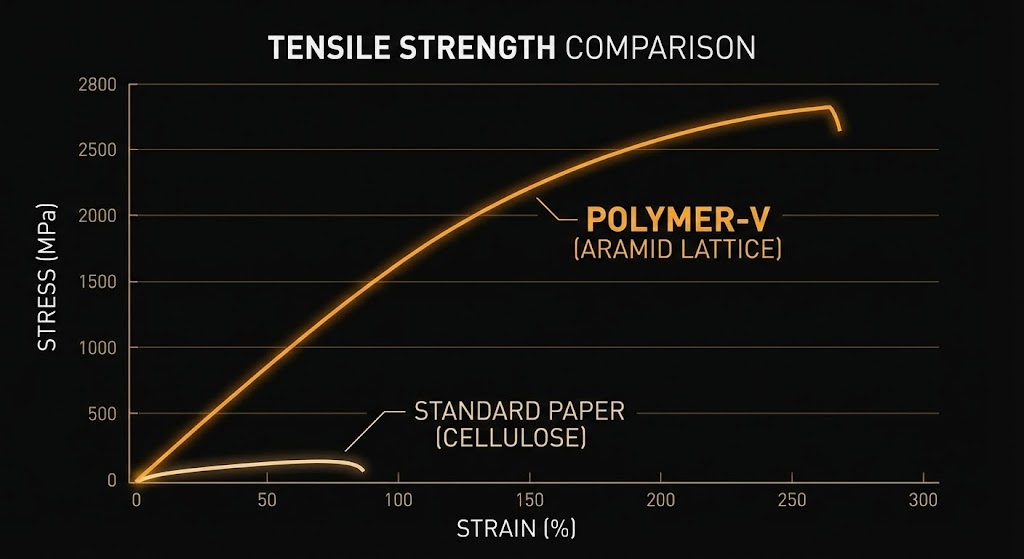
FIG 3.0: TENSILE STRENGTH COMPARISON
To support print speeds of 60 meters per second, the web tension must be immense.
Cellulose fibers tear at these loads. Polymer-V utilizes a Cross-Linked Aramid Weave (similar to Kevlar). It has a tensile strength 10x that of standard bond paper. It creates a book that is virtually impossible to tear by human hands.
03 // STRATIGRAPHY: COMPOSITE ARCHITECTURE
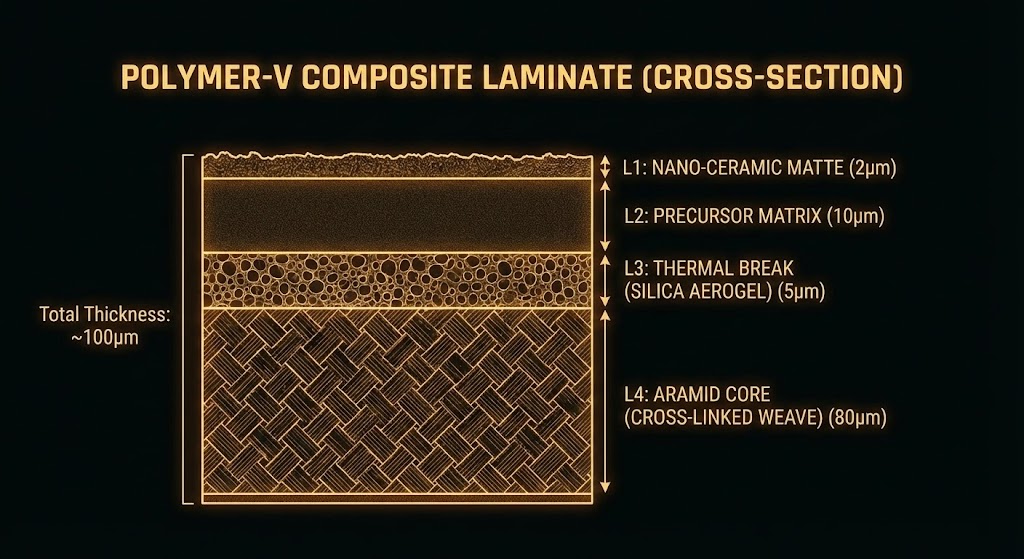
FIG 4.0: 4-PLY LAMINATE CROSS-SECTION
Polymer-V is not a homogeneous sheet. It is a 4-Ply Co-Extrusion engineered for specific physical loads.
Surface topography engineered to simulate 20lb bond paper. Hydrophobic. Provides friction coefficient for graphite/ink adhesion.
The "Active" layer. A dense hydrocarbon polymer that undergoes instant carbonization when struck by 10-15s laser pulses.
Vacuum-deposited Silica Aerogel. Prevents ablation heat from delaminating the structural core.
Cross-linked Kevlar-derivative weave. Provides the 2,800 MPa tensile strength required for 60m/s transport.
- [REF-01] Laser-Induced Porous Graphene Films from Commercial Polyimide. Lin, J., Tour, J.M., et al. ACS Nano, 8(11). (2014). [Proof of Laser-Carbonization].
- [REF-02] Insulating Properties of Aramid Nanofiber Films. Yang, M., et al. ACS Nano, 13(2). (2019). [Structural Lattice Integrity].
- [REF-03] Outgassing Data for Selecting Spacecraft Materials. NASA Reference Publication 1124. (Revised 2022). [Vacuum Stability Criteria].
- [REF-04] Thermal Conductivity of Carbonized Polymers. Fitzer, E. Carbon, Vol 28. (1990). [Heat Dissipation properties].
PART II — SUBSTRATE-X
"We don't cut trees. We arrange carbon."
Polymer-V was the proof. It demonstrated that a synthetic film could survive the vacuum chamber, endure Mach-speed transport, and accept femtosecond ablation. But it was a monochrome medium — optimized for the PP-01 through PP-04 Codex line. When the Chromium Program demanded full color, dual-format output, and gamma-triggered cover hardening from a single spool, we returned to the molecular drawing board.
The result is Substrate-X — classification: Bi-Stable Photo-Reactive Metamaterial. It is not paper. It is not plastic. It is programmed matter: a film designed to serve as the ammunition for the information age.
04 // THE TRI-LAMINATE — MATERIAL ARCHITECTURE
Substrate-X is a precision-engineered tri-laminate film, extruded at nanometer tolerances. Total thickness: exactly 80 microns — identical to high-quality book paper. But where Polymer-V stacked four discrete plies, Substrate-X uses three functional layers, the third of which permeates the other two.
Function: Haptics & Ablation.
Composition: Cellulose Nanofibril (CNF) Foam. We do not abandon cellulose — it provides the micro-roughness necessary for the human fingertip to register the material as "paper" rather than plastic. The CNF matrix is doped with Micro-Encapsulated Carbon Soot: capsules transparent to visible light (the page looks white) but highly absorptive of femtosecond laser frequencies.
When the Plasma Press laser hits this layer, the capsules detonate. They do not burn — they carbonize. The text is not printed on top; the white page becomes black text at a molecular level. Zero drying time. Zero smudging.
Function: Structural Integrity & Momentum Handling.
Composition: Biaxially Oriented Aramid-Polyamide — chemically similar to ballistic armor. This is the load-bearing spine.
It allows the Substrate-X ribbon to withstand the G-forces of accelerating to Mach 1.5 and the violent Thunder-Brake electrostatic deceleration in the stacking bin — without stretching, tearing, or deforming. A single sheet could theoretically tow a car.
Function: The Hard Cover Trigger.
Suspended throughout the entire film are dormant Gamma-Labile Cross-Linkers — monomer chains that under normal conditions (visible light, UV, heat) act as inert fluidizers, keeping the page flexible.
The Trigger: When exposed to a specific frequency of high-energy gamma radiation (the "Hardening Pulse" inside the Plasma Press), these monomers instantly form chaotic, rigid crystalline bridges between the Aramid chains.
The Result: Young's Modulus spikes by a factor of 500×. The flexible page calcifies into rigid, impact-resistant board. This allows the Plasma Press to print the cover using the exact same spool as the pages.
05 // THE LEVIATHAN — MANUFACTURING ENGINE
Substrate-X is not extruded. It is woven at the molecular level. The machine responsible is a 200-meter-long linear particle alignment system housed in its own dedicated foundry. We call it The Leviathan.
Raw cellulose slurry and liquid Aramid precursors are injected into a high-pressure manifold. Unlike paper pulp which settles randomly, The Leviathan uses Electro-Hydrodynamic Alignment: as the liquid exits the die, a massive voltage field aligns every single polymer chain in the direction of travel. This creates the "grain" of the film, maximizing tensile strength along the reel.
The extruded film enters a vacuum chamber where it is bombarded with the active ingredients — the Carbon Precursors and the Gamma Cross-Linkers. Method: Vapor Deposition. We do not mix these into the slurry (which would weaken the core). We infuse them into the porous structure of the still-hot film, ensuring even distribution without disrupting the Aramid lattice.
To lock the structure, the film passes through massive polished rollers chilled to −80°C by liquid nitrogen. The rollers determine the final texture:
MATTE — Micro-textured rollers imprint a "paper" grain
GLOSS — Polished sapphire rollers create a photo-ready surface
This flash freeze prevents the active chemicals from reacting prematurely.
06 // THE S-50 CASSETTE — KINETIC AMMUNITION
We do not ship pallets of paper reams. We ship kinetic ammunition.
The S-50 Cassette is a sealed, hexagonal cartridge made of recycled high-density polyethylene. It contains one continuous spool of Substrate-X:
LENGTH — 50,000 meters (50 km)
MASS — 350 kg
YIELD — ~20,000 standard 300-page textbooks per cassette
RELOAD — 8 seconds (robotic Mag-Load interface)
The cassette has no cardboard core. It mounts directly onto the magnetic spindle of the Plasma Press via the Mag-Load Interface. The machine engages the magnetic drive, spins the spool to match the vacuum chamber's internal velocity, and auto-feeds the lead tip into the laser array.
Gamma Shielding: Since gamma radiation triggers the hardening process, the film is acutely sensitive to background cosmic radiation during high-altitude air freight. The S-50 is lined with a 3 mm layer of Lead-Polymer Composite, preventing premature cross-linking. The film remains soft and dormant until intentionally triggered inside the Plasma Press. Shelf life: 50 years (if seal remains unbroken).
07 // DOCTRINE — THE FIVE ADVANTAGES
01 — ZERO WASTE
No bleed trim. No separate cover stock. 100% of the spool becomes book.
02 — SINGLE SKU
One cassette produces every part of the book. Logistics reduced to managing one inventory item.
03 — IMMORTAL
Waterproof. Tear-proof. Chemically inert. A textbook printed on Substrate-X survives a flood, a battlefield, or centuries of storage without degradation.
04 — BI-STABLE
Soft page or rigid board from identical stock. The material does not know what it is until the machine decides.
05 — KILL SWITCH
If a cassette is stolen or compromised, a remote signal triggers a small EMP inside the casing, destroying the Gamma-Linkers. The film will never harden into a cover. Proprietary material science, protected.
- [REF-05] Cellulose Nanofibril Foams: Structure-Property Relationships. Cervin, N.T., et al. Biomacromolecules, 14(2). (2013). [Layer A tactile skin basis].
- [REF-06] Biaxially Oriented Polyamide Films: Processing, Structure, and Properties. Kohan, M.I. Nylon Plastics Handbook. (1995). [Layer B tension core engineering].
- [REF-07] Radiation-Initiated Cross-Linking of Polymer Networks. Charlesby, A. Radiation Physics and Chemistry, Vol 18. (1981). [Gamma-labile cross-linker design].
- [REF-08] Electro-Hydrodynamic Alignment of Polymer Fibers in Thin Films. Theron, S.A., et al. Polymer, Vol 45. (2004). [Leviathan Zone 1 alignment principle].
- [REF-09] Chemical Vapor Deposition of Functional Coatings on Polymer Substrates. Tenhaeff, W.E., Gleason, K.K. Advanced Functional Materials, 18(7). (2008). [Zone 2 dopant infusion].
- [REF-10] Lead-Polymer Composites for Radiation Shielding Applications. Nambiar, S., Yeow, J.T.W. ACS Applied Materials & Interfaces, 4(11). (2012). [S-50 cassette gamma shielding].
Research Repository
Custom polymer feedstock manufacturing.
Manufactures the precision polymer reels consumed by Plasma Press machines. Material science optimized for laser ablation response, archival longevity, and variable surface hardness by layer. Polymer engineering at the molecular scale: chain architecture, tacticity, and cross-link density tuned to the exact ablation threshold of each laser wavelength. Cover layers are UV-cured with high cross-link density for scratch and moisture resistance; interior pages use lower cross-link formulations optimized for clean femtosecond ablation. Stimuli-responsive smart polymers, conjugated polymer thin films, and bio-based polymer feedstocks are active R&D programs aimed at reducing petrochemical dependency while maintaining sub-micron print fidelity.
Research & Bibliography- Emerging Trends in Engineering Polymers: A Paradigm Shift (Recent Progress in Materials, 2024) [Lidsen]
- Advances in Polymer Synthesis — Nature Communications collection [Nature]
- On-Demand Polymer Materials for Sustainability and Space (Annual Reviews, 2025) [Annual Reviews]
- Open Polymer Challenge: Post-Competition Report (arXiv, 2025) [arXiv]
- Synthesis of Advanced Polymer Materials 2.0 — Special Issue (IJMS, 2024) [MDPI]
- Recent Advances in the Synthesis of Bio-Based Polymers (ChemistrySelect, 2025) [ChemistrySelect]
- Bioplastics for a circular economy (Nature Reviews Materials, 2022) [Nature]
- Synthesis of Advanced Polymer Materials 3rd Edition — Open Special Issue (IJMS) [MDPI]
- 2D Conjugated Polymer Thin Films for Organic Electronics: Opportunities and Challenges (Advanced Materials, 2024) [Wiley]
- UV-Curable Polymer Nanocomposites: Material Selection, Formulations and Recent Advances (Journal of Composites Science, 2024) [MDPI]
- A Comprehensive Review of Stimuli-Responsive Smart Polymer Materials (Materials, 2024) [MDPI]
- Polymer Degradation for a Sustainable Future (Polymer Journal, 2024) [Nature]